
Reading a Hide

· 19 min read
What a hide actually is, how tanning works, and why one leather sofa lasts a decade while another lasts a lifetime. A guide to reading leather like a professional.
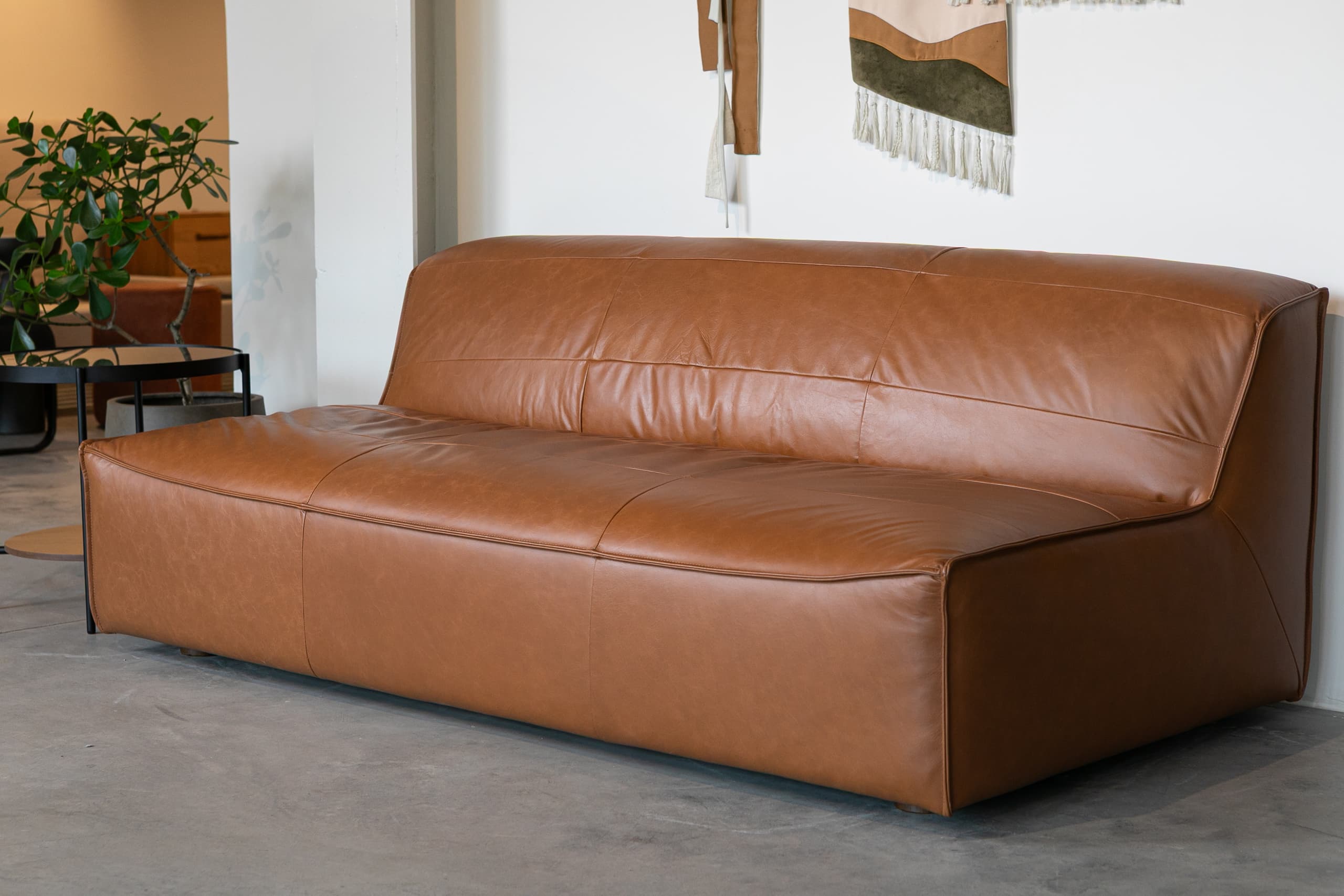
Every natural upholstery material was once alive. Linen was a flax stem, cotton a seed hair, wool a fleece. But all of them reach the sofa as fibers, harvested, spun, and woven into something new. Leather is different: it is not made from an organism, it is a piece of one. A hide arrives at the tannery as an intact organ, a structure that spent years protecting an animal, and it keeps that structure all the way to the living room.
That single fact explains nearly everything that follows: why no two hides match, why good leather gets better with age while fabric only gets older, why some leather cracks in four years, and why a sofa in a real aniline costs what a small car costs. Skin was built to shed water, resist abrasion, and heal. Turn it into furniture and it keeps doing the job. Turn it into furniture badly, or choose the wrong kind for the room, and it fails in ways that fabric never does. The difference is written in the hide before it reaches the tannery, and most of it is visible if you know what you are looking at.
What a hide actually is
Cut a hide in cross section and you find two layers doing two different jobs.
The top layer is the grain, the outer skin the animal lived in. It is thin, dense, and made of a tight mesh of collagen fibers packed so closely that it sheds water and resists abrasion. This is where the pores, the wrinkles, the scars and the character all sit.
Beneath it is the corium, much thicker and built of looser, larger collagen bundles running at an angle. It gives the hide its body and its tear strength. A single square centimeter of hide contains tens of millions of these fibers, woven in three dimensions, which is why a piece of leather one millimeter thick can outlast a woven fabric ten times its weight.
Everything in leather grading comes down to how much of the grain layer survives into the finished product. Keep all of it and you have full grain. Sand it down and you have corrected grain. Slice it off entirely and you are left with the corium alone, which is what suede and most "genuine leather" actually are.

The first myth: genuine leather is not a compliment
The leather trade has a vocabulary problem. Its most honest words have been borrowed by its least honest products.
Full grain means the grain layer is intact, nothing sanded, nothing embossed. Only the cleanest hides qualify, because every scar and insect bite will show. It is the strongest, the most expensive, and the only leather that develops true patina.
Top grain means the hide has been lightly sanded to remove surface blemishes and then usually embossed with an artificial grain pattern. It is still the upper layer and still durable. Most good furniture leather is top grain, and there is nothing wrong with that.
Corrected grain is top grain taken further: heavier sanding, a thicker pigment coat, a deeper emboss. Uniform, stain-resistant, and a little lifeless. Most commercial leather is this.
Split leather is what remains after the grain layer has been sliced away. It is the corium, sold on its own. It has no natural surface, so it is either brushed into suede or coated with polyurethane and embossed to imitate grain, at which point it is sold as "genuine leather" or, when the coating is thick, "bicast."
Bonded leather is not leather in any meaningful sense. It is shredded leather scrap, sometimes as little as ten to twenty percent by weight, mixed with polyurethane and rolled onto a fabric backing. It peels within a few years because the surface and the substrate have nothing in common.
The hierarchy is roughly this:
| Grade | What it is | Typical use in furniture | Lifespan |
|---|---|---|---|
| Full grain | Intact outer layer, unsanded | Aniline and pull-up leathers, premium sofas | Decades, improves with age |
| Top grain | Lightly sanded, usually embossed | Most quality sofas and chairs | 15 to 25 years |
| Corrected grain | Heavily sanded, heavily coated | Commercial and contract seating | 10 to 15 years |
| Split / "genuine" | Inner layer, PU-coated or brushed | Suede, budget furniture, backs and sides | 3 to 8 years |
| Bonded | Scrap and polyurethane on fabric | Budget furniture | 2 to 4 years, then peels |
A sofa labeled "genuine leather" is telling you, in the trade's own language, that the grain has been removed. A sofa labeled "full grain aniline" is telling you the opposite. Read the label the way the tannery wrote it, not the way the showroom says it.
How a hide becomes leather
A raw hide is a perishable piece of meat. Left alone it rots within days. Tanning is the chemistry that stops the rot permanently, and it has been done for roughly as long as humans have hunted.
The process has not changed in its outline for centuries, only in its speed.
Curing and soaking. The hide is salted or chilled within hours of leaving the animal, because decay starts immediately. At the tannery it is rehydrated, then soaked in lime and sulfide to dissolve the hair and swell the fiber structure open.
Fleshing and splitting. Machines scrape fat and tissue from the underside, and thick hides are sliced horizontally into a grain split and a flesh split. This is the moment that separates full grain and top grain from everything else. Enzymes then soften the hide and acid brings it to the pH the tanning agent needs.
Tanning. The tanning agent bonds permanently to the collagen. This is the irreversible step. Before it, the material is a hide. After it, it is leather.
Retanning, dyeing, fatliquoring. The leather is tanned a second time to adjust feel and fullness, colored through in a drum, and then fatliquored. Fatliquoring deserves a word, because it is the step most responsible for how a leather feels and the least known outside the trade. Tanning stops the hide from rotting, but it does not stop it from drying hard: dry a tanned hide with nothing else done to it and the collagen fibers bond to each other as the water leaves, producing something closer to rawhide than to a sofa. Fatliquoring prevents this. Oils are emulsified in water so they can travel deep into the hide, where they coat each fiber individually. When the water later leaves, the fibers slide against one another instead of locking together. Softness in leather is not a property of the hide. It is a property of the lubrication.
Drying and finishing. The leather is stretched, dried, softened by mechanical tumbling, and finally finished. The finish is where a tannery decides whether the result will be aniline, semi-aniline, or pigmented, and it is the single decision that matters most to a furniture buyer.
From hide to finished leather takes between three weeks and three months, depending almost entirely on the tanning method.

Chrome, vegetable, and the chemistry of not rotting
To understand tanning it helps to know what collagen is. It is a rope-like protein: three molecular chains twisted into a helix, the helices bundled into fibrils, the fibrils into fibers. Fresh, those chains are held together loosely, which is why raw hide is floppy, digestible, and food for bacteria. Tanning drives new chemical bridges between the chains, cross-links, that lock the structure permanently. A cross-linked fiber cannot be unraveled by enzymes, which is another way of saying it cannot rot. The proof is a number tanners call shrinkage temperature: raw hide contracts and gelatinizes in water at around sixty degrees Celsius, like any meat. Fully chrome-tanned leather survives past boiling. The material has been chemically rebuilt.
Two chemistries do this at scale.
Vegetable tanning builds the cross-links with tannins from bark and wood, chestnut, mimosa and quebracho among them. Large tannin molecules lodge between the collagen chains and hydrogen-bond them together, filling the hide as they do. The hides sit in pits of strengthening tannin liquor for weeks or months, and the result is firm, dense, warm-toned, and ages beautifully, darkening and burnishing with handling. It is also stiff and water-sensitive: a material for belts, saddles and bags rather than seating. Perhaps ten percent of world production.
Chrome tanning uses chromium (III) sulfate, and the chemistry is more elegant. Chromium (III) ions form coordinate bonds with the carboxyl groups that stud the collagen chains, and each ion can bond to two chains at once, stapling them together at the molecular scale. The staples are small, so the hide stays open, soft and light rather than filled and firm. The reaction runs in a day instead of a month. Discovered in the mid-1800s and commercialized in the 1880s, it is how eighty to ninety percent of the world's leather, and nearly all furniture leather, is made. The half-finished hides come out of the drum pale blue, the color of the chromium salt, which is why the trade calls them wet blue.
Is chrome-tanned leather safe? Yes. The confusion comes from two forms of the same element with very different characters. Chromium (III), the tanning salt, is a naturally occurring trace element, so benign that it is sold in pharmacies as a dietary supplement. Chromium (VI) is the industrial hazard, but its serious risks belong to the factory, not the living room: the documented cancer cases come from breathing chromium (VI) dust and fumes in plating shops and steel mills, at exposures no finished object can produce. A sofa cannot give anyone cancer, whatever window it sits in.
The reason chromium (VI) is discussed in leather at all is an allergy. Poorly made leather can develop trace amounts of it over time, through oxidation encouraged by heat, sunlight and the wrong finishing oils, and those traces can irritate the skin of the small minority of people already sensitized to chromium, the same population that reacts to cheap watch straps. This is a rash, not a health crisis, and it is also a solved problem: the European Union caps chromium (VI) in leather at three milligrams per kilogram, and competent tanneries formulate specifically so it never forms, then test to prove it. The Leather Working Group audits tanneries on exactly this, along with water treatment and effluent, and an LWG rating is the most useful single fact to ask a supplier for. The genuine environmental stakes of chrome tanning were never in anyone's furniture. They are in the wastewater of unregulated tanneries, which is a reason to buy audited leather, not a reason to avoid leather.
Chrome-free alternatives exist for specifications that require them. "Wet white" leathers are tanned with aldehydes or synthetic tannins, and newer plant-based systems are closing the softness gap. They remain a small, more expensive share of furniture leather.
The finish: aniline, semi-aniline, pigmented
Two sofas can be cut from the same wet blue and end up as completely different materials. The difference is the finish, and it is the most important choice in specifying leather.
Aniline is leather dyed through in a drum with soluble dyes and then left almost alone. No pigment on the surface, at most a light wax or oil. You see the actual skin: every pore, every healed scar, every variation in shade. Only the top few percent of hides are clean enough to qualify, which is the main reason it costs so much. Aniline is the softest, warmest, and most beautiful leather, and the least protected. It stains, it fades in sunlight, and it shows every mark, then gradually turns those marks into patina. A thirty-year-old aniline armchair is one of the best objects a house can contain.
Semi-aniline is aniline with a thin, partly transparent pigment coat on top. The grain still shows through, the hand is still soft, but the surface resists spills and light and wears more evenly. It is the sensible choice for most living rooms and nearly all hospitality work, and it is where the best value in furniture leather sits.
Pigmented, also called protected or finished leather, is coated with an opaque layer of pigment and polyurethane. The color is perfectly uniform, the surface wipes clean, and scars disappear beneath the coating. It is also the reason many people think leather feels like plastic, because on cheap pigmented leather it does. Good pigmented leather, with a thin coat over a decent top grain, is what most contract seating and most family sofas should be.

Pull-up leather is aniline loaded with oils and waxes so that when it is stretched or scratched, the oils move and the color lightens where it was pulled. It marks dramatically from the first day and looks magnificent after a decade. It is not for people who want a sofa to stay as it was delivered.
Nubuck is full grain sanded very lightly on the grain side to raise a fine velvet nap. It is aniline in its chemistry and softer than suede, and it is the most stain-vulnerable leather there is.
Suede is the flesh split, brushed to a nap. Pleasant to touch and cheap to make, it has no grain layer and therefore none of the abrasion resistance of full grain. It is a fine material for cushions and accent pieces and a poor one for seats.
| Finish | Surface | Feel | Stain resistance | Light resistance | Hides that qualify | Relative cost |
|---|---|---|---|---|---|---|
| Aniline | Bare, dyed through | Softest, warmest | Low | Low | Top 5 to 10% | Highest |
| Pull-up | Oiled and waxed aniline | Soft, oily | Low | Low | Top 10% | High |
| Nubuck | Lightly sanded grain, napped | Velvet | Very low | Low | Top 10% | High |
| Semi-aniline | Light pigment over dye | Soft | Moderate | Moderate | Top 20 to 30% | Medium to high |
| Pigmented | Opaque pigment and PU | Firmer, smoother | High | High | Most hides | Medium |
| Suede | Napped flesh split | Soft, fibrous | Very low | Moderate | Any | Low to medium |
The rule the tanneries use is simple and worth remembering: the more natural the leather, the more care it needs and the better it ages. Protection and patina are a trade. You cannot have the most of both.
Reading the marks
An aniline hide arrives with a biography, and learning to read it is the difference between a flaw and a feature.
Neck wrinkles are the fold lines from the animal turning its head. They are most visible on the shoulders of a hide and are a sign that the leather is natural rather than sanded.
Healed scars are where the animal caught itself on wire or a branch. The skin repaired itself and the scar tanned with the rest.
Insect bites are small pinprick marks, and they cluster on hides from warm climates where biting insects are common. Scandinavian and northern European hides show far fewer, which is one reason they are prized for aniline.
Fat lines and grain variation are subtler: streaks and shifts in texture that show how the animal grew.
A hide graded for aniline has almost none of these in the areas that will become seats and arms. A hide with too many becomes semi-aniline, where pigment softens them, or pigmented, where the coating hides them, or is sanded into corrected grain. Nothing is wasted; the marks simply determine what the hide is allowed to become. This is also why origin matters: cool climates, low insect activity and good husbandry produce cleaner, more consistent hides, and the best tanneries source from specific regions and, increasingly, specific farms.
The animal matters too. Nearly all upholstery leather comes from cattle, and within cattle the distinction that counts is cow versus bull. Some of the best furniture leather comes from dairy cows, whose hides tend to be fine-grained and consistent. Bull hides are bigger, thicker and stronger, with heavy necks and more pronounced wrinkles: excellent where strength and character are wanted, less suited to a fine aniline. Buffalo hides appear now and then, with a deeper, more rugged grain. Everything more exotic, ostrich, crocodile and the rest, is real leather but a rarity in upholstery: small, expensive, and best treated as an accent, not a seat.
Durability, honestly
Leather's reputation for durability is earned, but it is earned by the right leather in the right place.
Thickness. Furniture leather is usually shaved to between 0.9 and 1.2 millimeters for upholstery and up to 1.4 for heavier seating. Thinner leather drapes better over curves and feels softer. Thicker leather resists wear longer and suits tight, flat panels. Neither is better; the design decides.
How the trade measures it. Fabric durability is sold on one number: the Martindale rub count, where a machine rubs the textile in circles until it wears through. Twenty thousand rubs is domestic quality, forty thousand is contract grade, and the number is printed on the swatch card. Leather never gets a Martindale figure, and its absence confuses buyers into thinking leather is untested. In fact it is tested on three counts, all of them tougher measures than abrasion:
| Test | What it measures | What to look for in furniture leather |
|---|---|---|
| Colour fastness to rubbing | Cycles of dry and wet rubbing before the finish transfers or dulls | 500+ dry, 250+ wet, rated 4 to 5 on the gray scale |
| Flex endurance | Repeated folding on a flexometer before the surface cracks | 50,000 flexes minimum, 100,000+ for contract |
| Tear strength | Force in newtons to propagate a tear | 20 N or more for upholstery |
The reason leather skips the Martindale is that a decent top grain does not wear through: the grain layer outlasts the machine's useful range, and long before abrasion mattered, the piece would fail somewhere else. What actually wears on a leather sofa is the finish, dulling on an arm or a cushion edge after years of contact, and that is what the rub-fastness test predicts. It is also a surface, not a structure, which brings us to repair.
Repairability. When a fabric is damaged, the remedy is removal: the torn or worn textile is stripped off and thrown away, and the piece is reupholstered or replaced, because a woven cloth cannot be convincingly mended in place. Leather works the other way. It is repaired, not replaced. A scuff on aniline buffs out with conditioner. A scratch on pull-up disappears under a thumb as the oils re-flow. A worn or even torn panel on pigmented leather can be cleaned, filled, re-dyed and re-sealed by a professional in a day, and the repair is invisible because the finish was always a coating to begin with. A leather sofa is the only piece of upholstery in the house that gets maintained the way the house itself does.
Climate. Leather is a hygroscopic material like wood: it takes on and gives up moisture with the air. In a dry, heated interior it loses oils and can stiffen and crack if neglected. In a humid, tropical interior like Panama the risk runs the other way, toward mildew on the underside of cushions in a room without air conditioning. Aniline suffers most in both directions because it has no coating to slow the exchange. A conditioned room and a wipe-down every few weeks solve nearly all of it.
Sunlight. Ultraviolet light fades aniline noticeably within a year or two in a bright window and slowly degrades the surface oils of everything else. Pigmented leather shrugs it off. Aniline and pull-up should be placed with the same care as a good rug.
Care, by type
The care routine follows directly from the finish.
All leather. Dust it. Wipe spills immediately with a barely damp cloth. Keep it out of direct sun and away from heat sources. Never use furniture polish, saddle soap, solvents, or anything with silicone or oil not made for upholstery leather.
Aniline, pull-up, nubuck. Apply a protector when new and repeat every six months. Use a leather conditioner once or twice a year, more in air-conditioned rooms. Accept that the first stain is the hardest and that the leather will look better at year five than at year one.
Semi-aniline. Wipe with a damp cloth and a pH-neutral leather cleaner as needed. Condition once a year. Protector is useful but optional.
Pigmented. Wipe clean. Use a leather cleaner for anything stubborn. Conditioning is rarely needed because the coating does the work, but a light application every couple of years keeps the top coat from drying out.
Suede and nubuck. Brush with a suede brush to lift the nap. Use a protector spray from day one. Blot liquids, never rub.
What goes wrong is almost always one of three things: a spill left overnight, a sofa placed in a sunny window, or a product bought at a supermarket and applied to an aniline.
A short history
Leather is older than pottery, weaving, or agriculture, and the first tanning was almost certainly an accident: skins smoked over a fire or soaked in water with fallen bark lasted longer than skins that were not. The oldest leather object yet found is a 5,500-year-old shoe from a cave in Armenia. Ötzi, frozen in the Alps around 3300 BC, was dressed in leather head to foot. Egyptian tombs hold leather sandals in remarkable condition, and the Romans equipped their legions in vegetable-tanned hide.
For the next two thousand years the process barely changed: slow, foul-smelling pit tanneries pushed to the edges of towns, fed on oak bark for so long that tanning and forestry were effectively one trade. Then chrome arrived, and like many great inventions it was discovered twice: by the Swedish chemist Carl Hyltén-Cavallius in the 1840s and, independently, by the German chemist Friedrich Knapp, who published in 1858. An American, Augustus Schultz, patented a practical process in 1884, and within thirty years chrome had taken over the world. What took months now took hours, in any color, soft enough for gloves and seats, at a price that put leather in every middle-class house.
The modern tannery is a water-treatment plant with a leather business attached: chemistry monitored, effluent regulated, hides traced back to the farm. The hides themselves remain what they have always been, a by-product of the meat and dairy industries. No cattle are raised for leather. The tannery's function is to make sure the skin of an animal raised for food does not go to waste.
Why the price varies so much
A leather sofa can cost two thousand dollars or forty thousand. Most of the gap is explained by three things.
The grade of the hide. Only a small fraction of hides are clean enough for aniline. The tannery pays for the whole hide, so the best ones carry a premium that covers the rest. This is also why aniline costs more than pigmented: not the chemistry, the selection rate.
The yield. A cattle hide is about five square meters, roughly a third of it unusable for upholstery, and a large sofa takes six to eight hides. A sofa cut entirely from the prime centre of full-grain hides consumes more of them than one that tucks split leather around the back and sides, which is exactly what most mid-priced sofas do. Ask whether the leather is the same all the way round.

What you are paying for, in the end, is selection. The cheaper the leather, the less anyone had to choose.
Five questions to ask
Is it full grain, top grain, or split? If the answer is "genuine leather," the grain has been removed.
Is it aniline, semi-aniline, or pigmented? This decides how it feels, how it ages, and how much care it needs.
Is the leather the same on the back and sides as on the seat? Many sofas are not.
Where is the tannery, and is it LWG-rated? This is the chromium question, asked properly.
Where will it sit? A window, a family room, a hotel lobby, and a study each want a different leather. The best leather is the one whose trade-offs match the room.
Choose well and a leather sofa becomes the rare object in a house that improves with use. It will arrive looking new and spend the next thirty years looking better.
Updated September 11, 2026
About the author
I'm Gabriel, cofounder of Mansa Furniture. I studied industrial engineering, built a career as a software engineer, and have liked woodworking since I was a teenager. I didn't realize all three had something in common, my real passion: functional design, building things that help people do things easier and live better. I bring an engineer's habits to furniture, paying close attention to materials and processes, always asking what actually adds value to a piece of furniture.
Frequently asked questions
Is "genuine leather" good leather?
No, it's a grade, not a compliment. In trade terms, genuine leather means the grain layer has been removed and the split coated to imitate it. Look for full grain or top grain instead.
What is the difference between full grain and top grain leather?
Full grain keeps the hide's outer layer intact, with all its character, and is the strongest and only kind that develops true patina. Top grain has been lightly sanded and usually embossed, and remains durable. Most of the good furniture leather is top grain.
What's the difference between aniline, semi-aniline, and pigmented leather?
Aniline is dyed through with no surface coating: the softest and most beautiful, and the least protected. Pigmented is coated with opaque color: the most stain- and light-resistant, but less natural to the touch. Semi-aniline sits between and is the best value for most homes.
Is chrome-tanned leather safe?
Yes. The tanning salt is chromium (III), a benign trace element. The concern people cite, chromium (VI), is an industrial workplace risk, and in finished leather it's regulated to trace limits. Buying from an LWG-rated tannery settles the question.
How long does a leather sofa last?
It depends on the grade: full grain and top grain last decades and improve with age, corrected grain 10 to 15 years, split and bonded leather far less. Unlike fabric, leather is repaired in place rather than reupholstered.
How do I care for a leather sofa?
Dust it, wipe spills immediately with a barely damp cloth, and keep it out of direct sun. Aniline needs a protector and conditioner once or twice a year; pigmented leather mostly just needs wiping. Never use furniture wax, solvents, or household cleaners.
Which animals does upholstery leather come from?
Nearly all of it is cattle. Some of the best hides come from dairy cows; bull hides are thicker and stronger with more pronounced wrinkles; buffalo appears occasionally. Exotics like ostrich and crocodile are rare in upholstery and best used as accents.
Comments (0)
No comments yet. Be the first to write one.


